How to Measure the Light in a Spot With Your Phone
Where to put the phone, why you step back, what gentle, medium, bright and full sun mean in lux, and how far to trust the number. With a test against a real lux meter.
TL;DR: Lay the phone flat where the plant will stand, screen facing up. Step back while it measures, because your own shadow is the biggest error there is. Read the light word first (gentle, medium, bright or full sun) and treat the lux figure as a rough guide. Measure at midday on a bright day, and again when the season turns.
Plant tags talk about light, and almost nobody knows how much light a spot in their home gets. Your eyes are no help: they adapt so well that a room at 500 lux and a windowsill at 15,000 lux both look "bright". A plant feels the difference within weeks.
A phone can tell them apart. Here is how to get a reading you can use.
How a phone measures light at all
iPhones have an ambient light sensor, the thing that dims your screen in a dark room, but iOS does not let apps read it. What an app can read is the camera's exposure: how long the shutter stays open and how much the sensor is amplified to make a picture look right. Bright light needs little of either, dim light needs a lot, and that relationship can be turned back into an estimate in lux.
That estimate is good at the question a plant asks (is this spot gentle, medium, bright or full sun?) and weaker at the exact number. Keep both halves in mind and a phone becomes a useful light meter.
Step 1: put the phone where the plant will stand
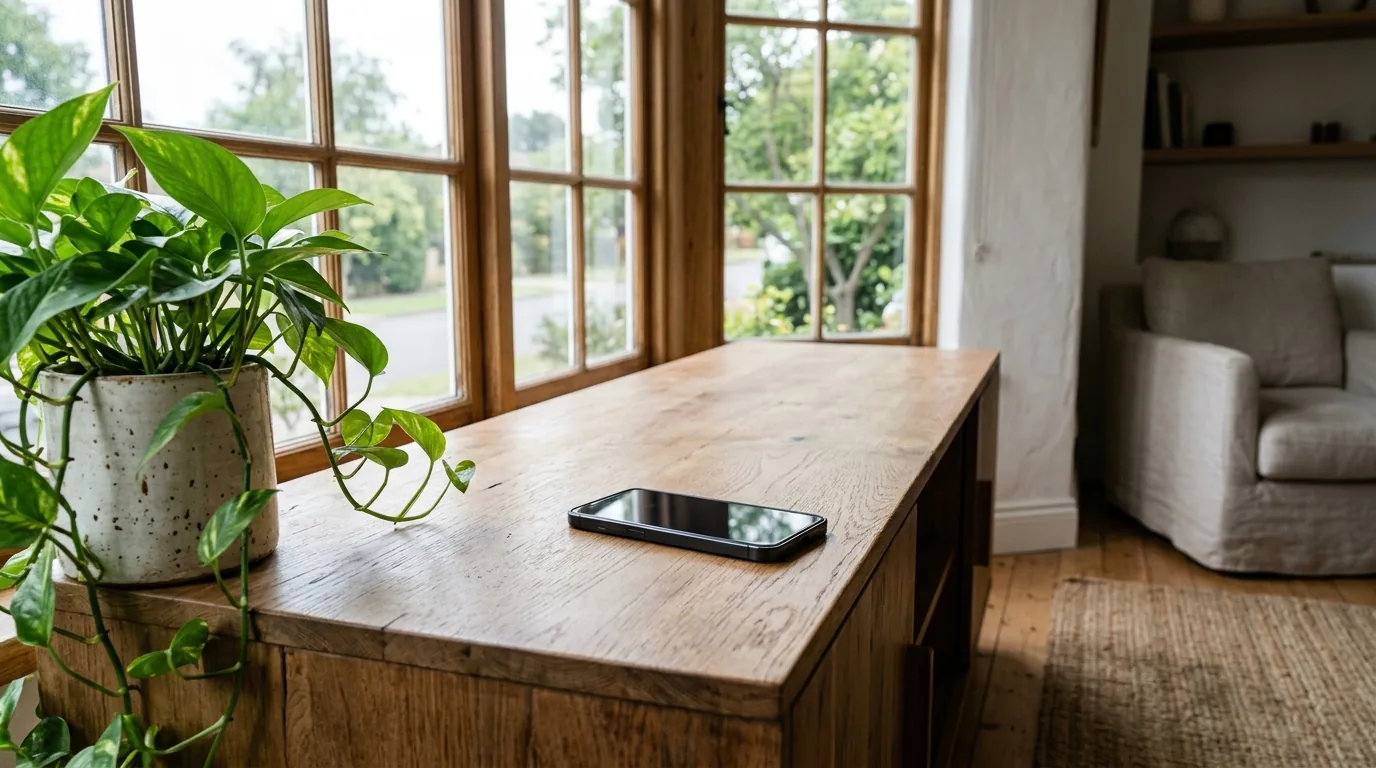
Measure the spot, never the plant. Lay the phone flat on the shelf, sill or floor where the pot will go, screen facing up. The front camera sits next to the screen, so it now looks at the light arriving at that spot, the way a leaf receives it.
A few things quietly ruin a reading:
- The phone is tilted. Solspot shows how flat it is and waits until it is.
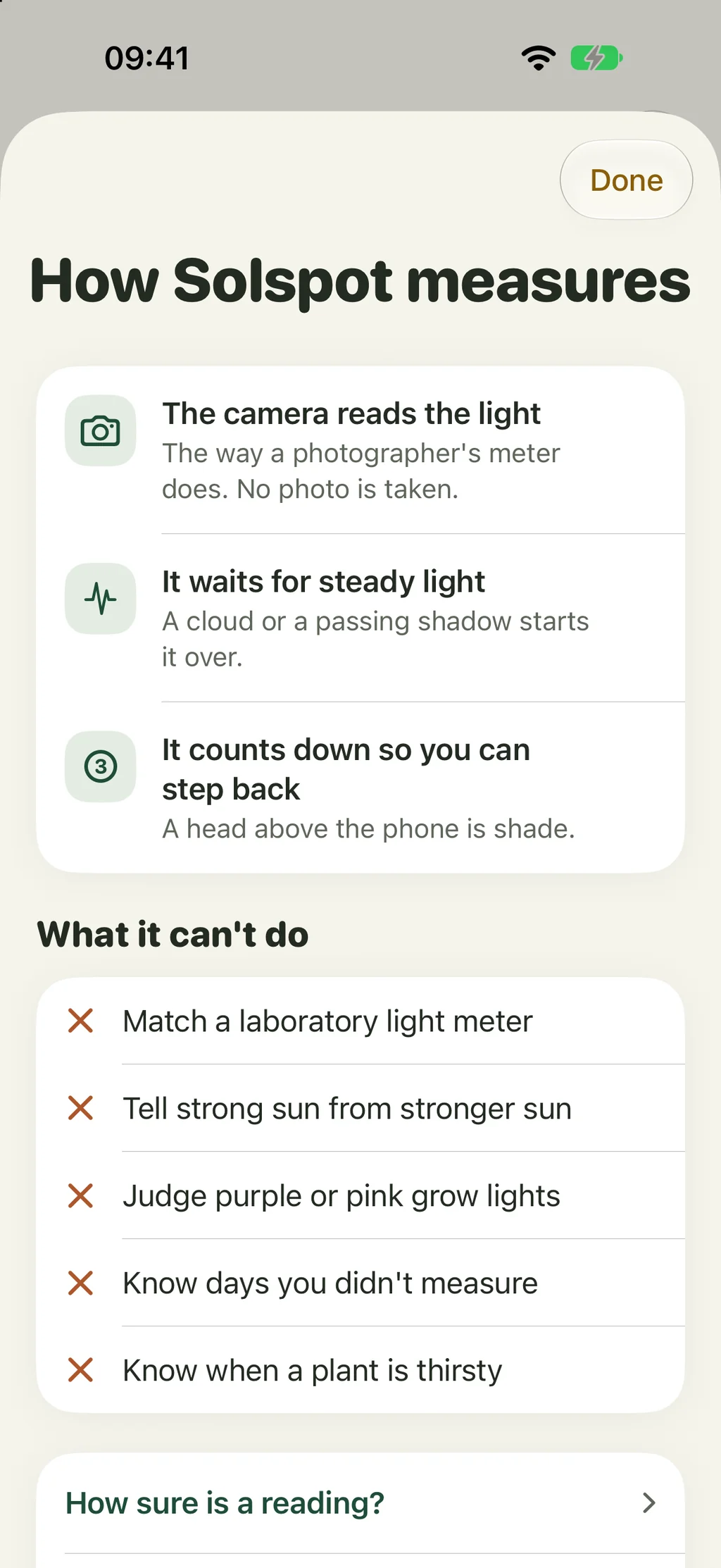
- Something covers the camera. A case lip, a finger or a sticker. Solspot notices a covered sensor and asks you to try again.
- The light is changing. A cloud passing or a lamp switching on starts the measurement over.
- The phone is pointed at the plant. That measures light bouncing off leaves, which is a different and much smaller number.
Step 2: step back
This is the step everyone skips, and it is the one that matters most. The camera is looking up, so whoever stands over the phone to watch the screen is in its view as shade.
In Solspot 2.0 the measurement starts by itself once the phone is flat and the light is steady, then counts down so you can step away. If you have switched the automatic start off, tap Measure this spot and the same countdown runs.
Our test, October 2026. We put the phone under a white desk lamp next to a UNI-T UT383 handheld lux meter. Leaning over the phone to watch it, Solspot read between a fifth and a third of the meter. Stepping back during the countdown, it read like this:
| Lux meter | Solspot, after stepping back | Light word |
|---|---|---|
| 4,917 | about 6,600 | Medium, correct |
| about 2,390 | about 1,400 | Gentle, correct |
| 834 | about 780 | Gentle, correct |
The numbers wander, by a third in one direction and almost half in the other. The light word was right all three times. That is the honest summary of what a phone can do, and it is why the word comes first. The test also settled one worry: a white household LED reads like daylight, so a lamp that is on during the day is light your plant really gets.
Step 3: read the light word first
Solspot names the light the way plants feel it, with the lux beside it:
| Light word | Lux | What it looks like |
|---|---|---|
| Gentle light | Under 2,500 | Most of a room away from the window, or a room lit by lamps |
| Medium light | 2,500 to 10,000 | A few steps back from a good window, or a bright room on a cloudy day |
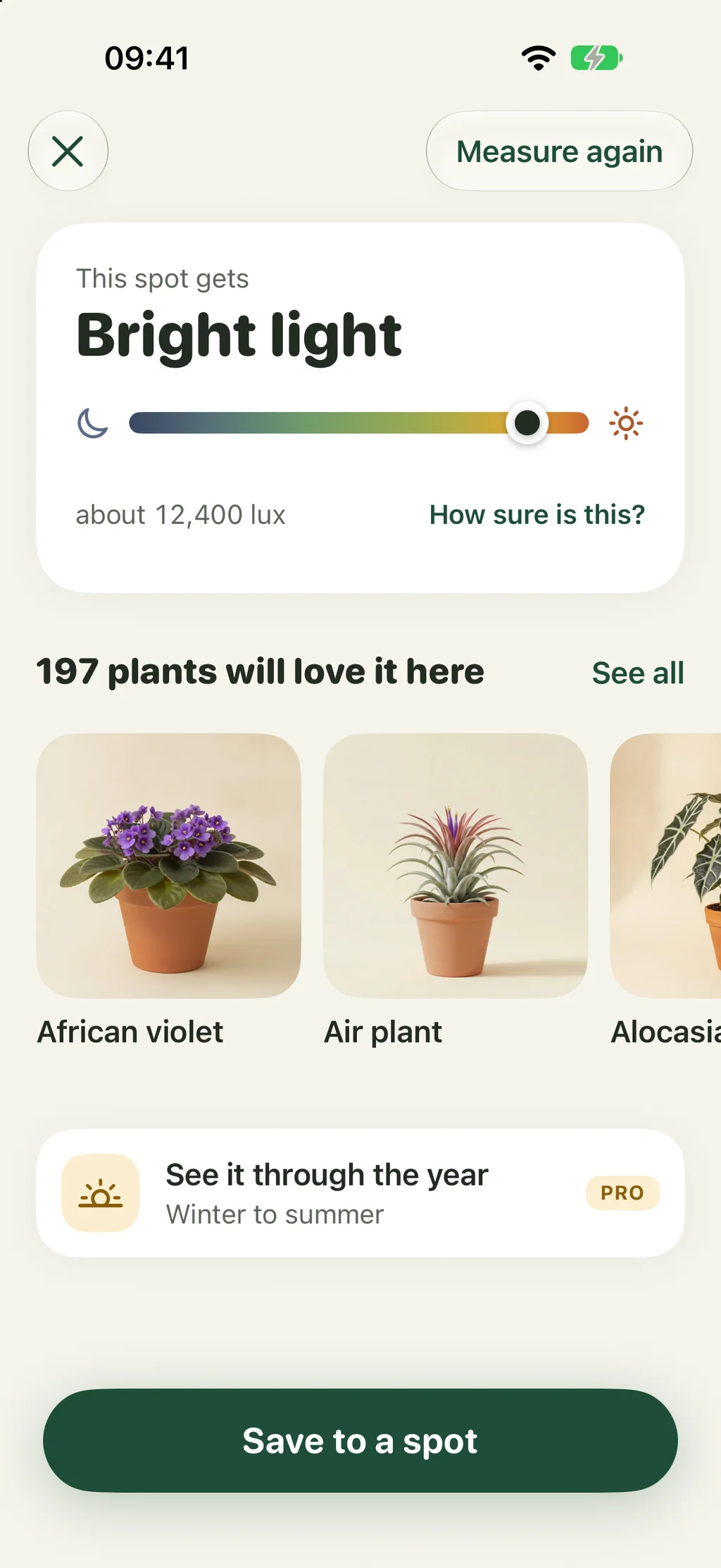
| Bright light | 10,000 to 20,000 | Right at unobstructed glass, with no sun on the spot |
| Full sun | 20,000 and up | Sun falling on the spot itself |
Plants are matched on the word, not on the exact figure, because the word survives the error the figure carries. If you want the long version of what "bright indirect light" means on a plant tag, we wrote a whole article on it.
Above 20,000 lux the camera cannot tell strong sun from stronger sun, so Solspot shows "20,000+" rather than a number it cannot back up.
How sure is a reading?
Tap How sure is this? under any reading and Solspot shows the range the real light could sit in. Until a phone model has been calibrated against a meter, that range is wide, and the app says so rather than printing one confident number. The short version it gives you: trust the kind of light, and treat the number as a rough guide.
There is one place a phone is very good: comparing spots. The same phone, measured the same way, is wrong in the same direction every time, so "is the bookshelf brighter than the desk?" has a reliable answer even when neither number is exact.
When to measure, and when to measure again
Light moves through the day and through the year. For the most useful single reading:
- Measure around midday on a bright day. That is when a window gives the most light, so it tells you how bright the spot can get.
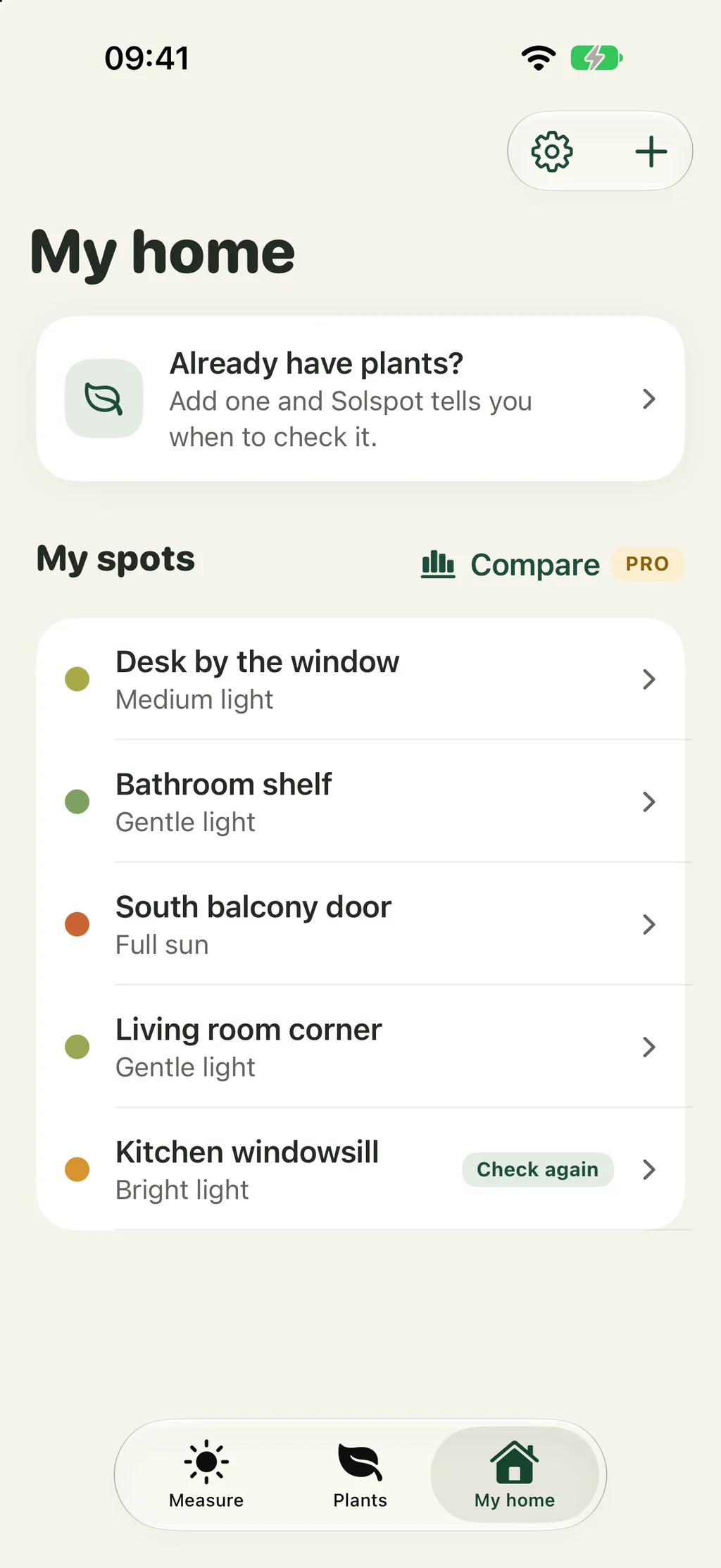
- Save it to a spot. My home lists your spots with their light words, so you can compare the desk, the shelf and the sill at a glance.
- Measure again when the season turns. A sill that reads bright in June can be medium in December. When you save, Solspot can remind you to measure again at midday, and it flags spots that are due a re-check.
The short version
Phone flat, screen up, where the plant will stand. Step back. Read the word, then the number. Measure at midday, and again in another season. That is all a good reading takes, and it beats any amount of guessing from across the room.

Common questions
Can an iPhone really measure light for plants?
Well enough to sort a spot into the right kind of light, which is what choosing a plant needs. The phone works back from how its camera exposes to an estimate in lux. It is not a lab meter, and a single number can be off by a lot, but in our test against a handheld lux meter the light word was right in all three readings taken the proper way.
Which way should the phone face?
Flat, with the screen facing up, where the plant will stand. The front camera sits beside the screen, so it then looks at the light arriving at that spot from above and from the window, the way a leaf receives it. Do not point the phone at the plant.
Why does Solspot count down before measuring?
So you can step back. Whoever leans over the phone casts shade on it. In our test, leaning over the phone read between a fifth and a third of what a lux meter said, and stepping back fixed it.
When is the best time to measure?
Around midday on a bright day, when a window gives the most light, and again in a different season. A spot that is bright in June can be medium by December.
More from the blog
All articles →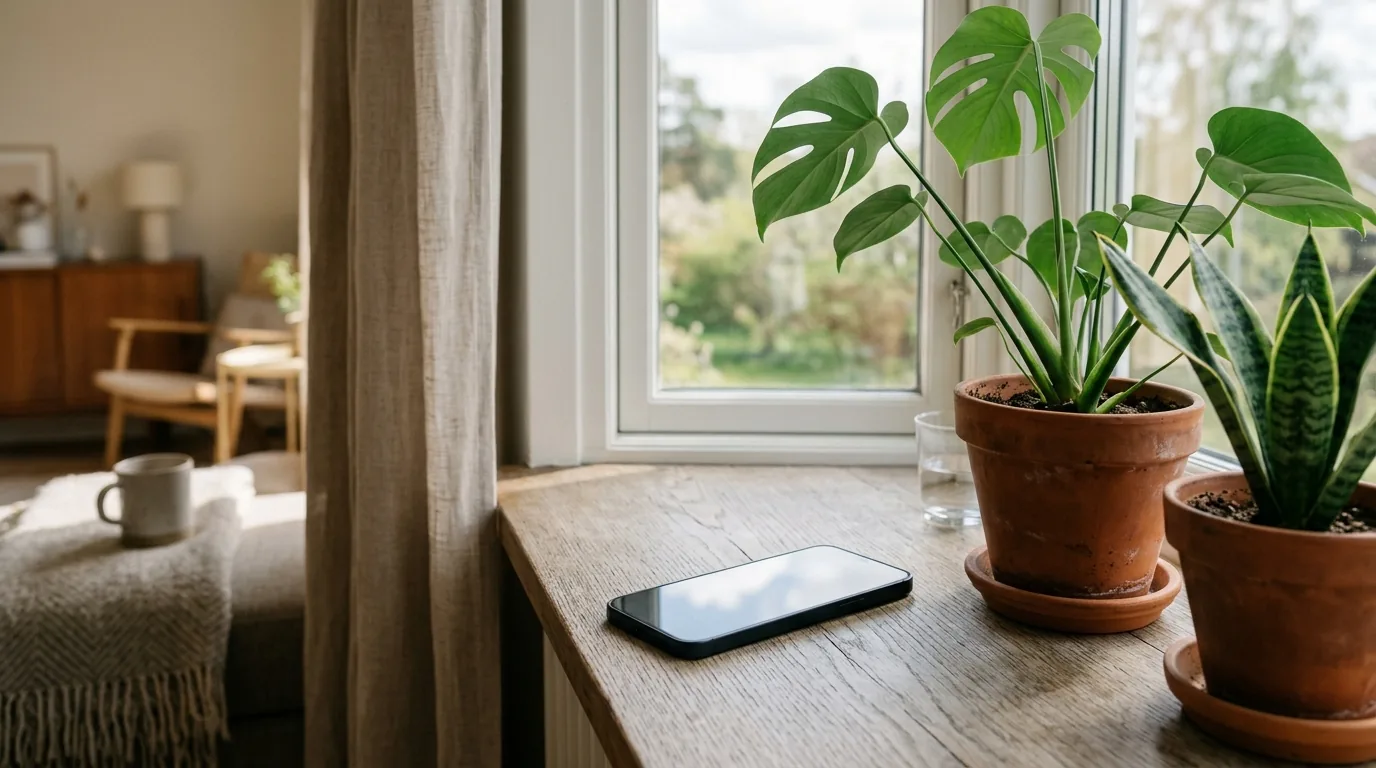
Solspot 2.0: Measure a Spot, See What Will Grow There
Solspot 2.0 is a new design built around one question: what will grow here? Lay the phone down and it measures, the reading speaks plant, and the plants that suit the spot come with the answer.
Read the article · 4 min read
Can Your Houseplants Go Outside for the Summer? Check the Coldest Night
Warm afternoons are not the limit. The coldest night of the month is, and in Munich, Paris or London even July has nights too cold for a monstera. Here are the numbers for five cities and six plants.
Read the article · 5 min read
Which Houseplants Are Actually Safe for Cats and Dogs
Most pet-safe plant lists have two answers. The real data has three. Of 100 common houseplants, 28 are listed non-toxic, 33 are listed toxic, and 39 nobody has settled.
Read the article · 8 min read