Can Your Houseplants Go Outside for the Summer? Check the Coldest Night
Warm afternoons are not the limit. The coldest night of the month is, and in Munich, Paris or London even July has nights too cold for a monstera. Here are the numbers for five cities and six plants.
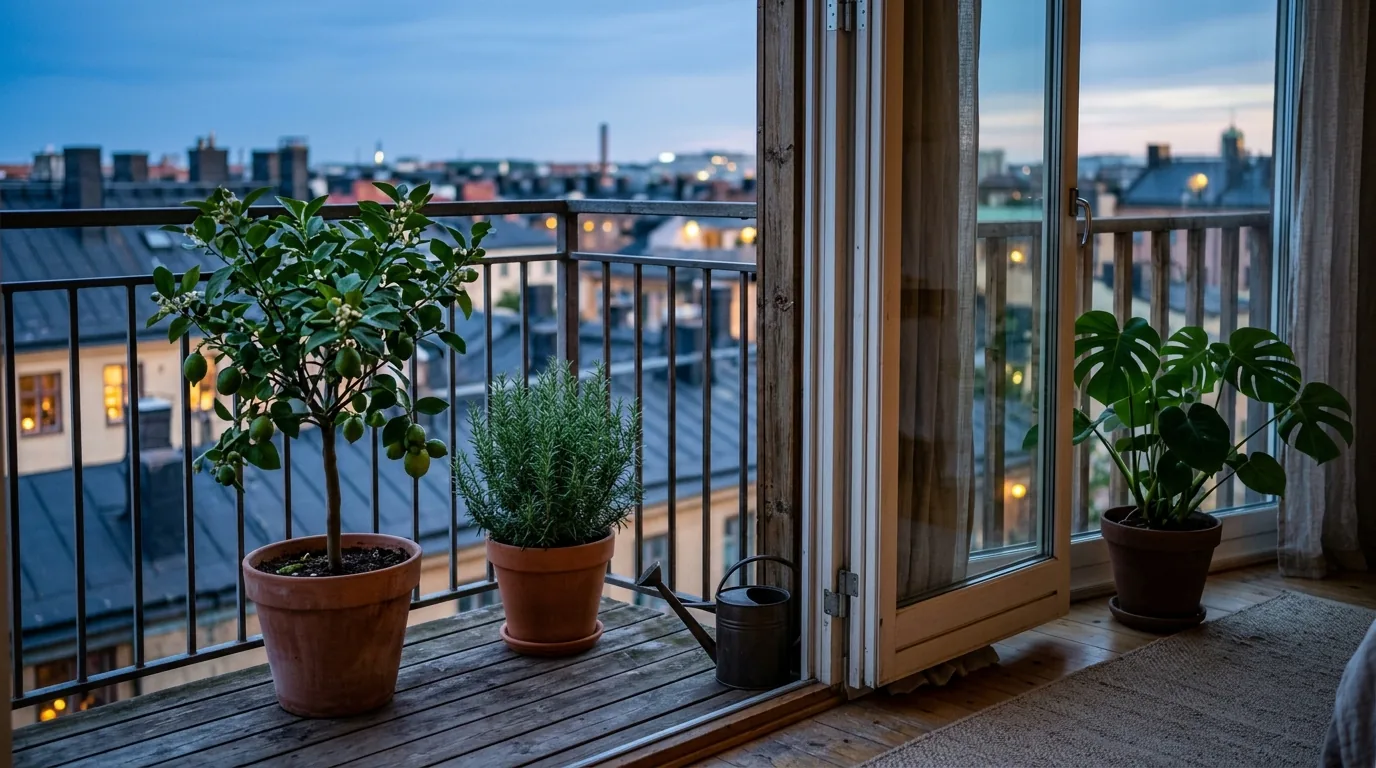
TL;DR: Whether a houseplant can spend the summer outside depends on the coldest night of the month, not on warm afternoons. Many tropical houseplants want at least 10 to 15 °C. In an average year the coldest July night is about 8 °C in Munich, 9 °C in Paris and London, and 10 °C in Berlin. So a lemon tree, an olive or rosemary can go out for months, and a monstera should stay in.
It is a lovely idea: carry the plants onto the balcony in June, let them soak up real daylight all summer, bring them back in September. For some plants it works very well. For others, one cold night in July undoes a year of growth, and you only find out when the leaves turn.
The number that matters is the coldest night
Every plant has a lowest temperature it takes without damage. For most tropical houseplants that is somewhere between 10 and 15 °C (50 to 59 °F). Cacti and succulents often take less, Mediterranean shrubs much less.
The trap is comparing that number with the wrong weather figure. A July "average" of 18 °C sounds safe, but it is a mix of warm afternoons and much cooler nights. What the plant has to survive is the coldest night it meets while it is outside.
So the useful figure is the coldest night of an average month: take each year's coldest night in July, and average those. It is not the record low (one freak night decades ago would rule out every summer), and it is not the average night (half the nights are colder than that).
Here it is for five cities, from NASA's POWER climate data, the same figures Solspot uses:
| City | June | July | August |
|---|---|---|---|
| Munich | 6.4 °C | 8.1 °C | 7.8 °C |
| Berlin | 7.2 °C | 10.0 °C | 9.5 °C |
| Paris | 6.7 °C | 9.3 °C | 8.7 °C |
| London | 6.2 °C | 8.9 °C | 8.0 °C |
| Marseille | 10.6 °C | 13.5 °C | 12.9 °C |
Even in high summer, central and northern Europe gets nights under 10 °C in an ordinary year.
What that means for six common plants
Put the two numbers side by side and the answer is often surprising. These are the months each plant can stay outside, worked out the way Solspot does it, with the lowest temperature from Solspot's plant database:
| Plant (lowest temperature) | Munich | Berlin | Paris | London | Marseille |
|---|---|---|---|---|---|
| Monstera (15 °C) | Too cold | Too cold | Too cold | Too cold | Too cold |
| Snake plant (10 °C) | Too cold | Jul | Too cold | Too cold | Jun–Aug |
| Jade plant (7 °C) | Jul–Aug | Jun–Aug | Jul–Aug | Jul–Aug | Jun–Sep |
| Lemon tree (5 °C) | Jun–Aug | Jun–Sep | Jun–Sep | Jun–Sep | May–Sep |
| Olive tree (−5 °C) | Apr–Oct | Apr–Nov | Mar–Dec | All year | All year |
| Rosemary (−10 °C) | Mar–Nov | Feb–Dec | All year | All year | All year |
A few things stand out:
- The monstera stays in everywhere on the list. Its 15 °C floor is above the coldest July night in all five cities.
- The snake plant is borderline. One month in Berlin is not a season; a Marseille summer is.
- The jade plant gets two months in most of these cities. That is warm enough, but short enough that moving it out and back may not be worth the shock.
- The lemon tree is the classic balcony plant for a reason. Three or four months nearly everywhere, and more in the south.
Why the rule is strict
Solspot counts a month only when its coldest night stays at or above the plant's lowest temperature, and it only calls it a season when three or more months in a row qualify. That sounds cautious, and it is meant to be. A plant left out for a month has to get through every night of that month, not the typical one. Two good months in a row show on the plant's care guide, so you can still decide for yourself, but they do not count for the filter.
Light is the other half
Outside is far brighter than any room. Open shade on a balcony is often brighter than the best windowsill indoors, and direct summer sun goes well past 20,000 lux. Leaves that grew indoors are not used to that and can scorch, so start a plant in shade for a week or two before it gets any sun.
That also means the light question indoors still matters most. A plant that will spend nine months on your windowsill has to suit that windowsill first. If you have not measured it yet, here is how to measure the light in a spot.
How Solspot works it out for your town
In Solspot 2.0, open Filters in the Plants tab and choose Can live outside. Tell it where you live, either by allowing your location (rounded to about 10 km, kept on the phone) or by picking your town from the list. You can then show only plants that can live outside for three months or more, or all year.
On any plant, the care guide then shows a line like "Outside in Munich: Jun–Aug", or "Too cold all year". The climate data for 4,205 places is built into the app, so this works offline, and like every filter it is free.
What it cannot tell you
The numbers describe an average year, and you live in a real one:
- A cold snap can still happen. Watch the forecast in late spring and late summer, when the margins are smallest.
- Your balcony is not the weather station. A sheltered south wall in a city can be several degrees warmer at night than open ground nearby, and an exposed roof colder.
- Cold is not the only risk. Heavy rain on a succulent, wind on a tall plant, and pests that come back indoors with it in September are all worth a look.
The coldest night is still the best single number to decide with. Most of the time, it says yes to the lemon tree and no to the monstera.

Common questions
When can I put my houseplants outside?
When the coldest night of the month stays at or above the lowest temperature the plant takes, for the whole time it is out. Use the coldest night of an average month, not the average temperature: a plant outside for a month has to get through every night of it.
Can a monstera go outside in summer in Germany, France or the UK?
Usually not, if you go by the nights. A monstera wants at least 15 °C. In an average year the coldest July night is about 8 °C in Munich and about 9 °C in Paris and London. Only the warmest parts of the Mediterranean come close, and even Marseille reaches about 13.5 °C.
What about a few warm weeks?
A warm spell is a gamble, not a season. Solspot only calls it a season when three months or more in a row are warm enough, and shows shorter runs on the plant's care guide so you can decide for yourself.
Does Solspot use my location for this?
Only if you allow it, and then it is rounded to about 10 km and stays on your phone. You can also just pick your town from the list. The climate data for 4,205 places is built into the app, so nothing is looked up online.
More from the blog
All articles →
Solspot 2.0: Measure a Spot, See What Will Grow There
Solspot 2.0 is a new design built around one question: what will grow here? Lay the phone down and it measures, the reading speaks plant, and the plants that suit the spot come with the answer.
Read the article · 4 min read
How to Measure the Light in a Spot With Your Phone
Where to put the phone, why you step back, what gentle, medium, bright and full sun mean in lux, and how far to trust the number. With a test against a real lux meter.
Read the article · 5 min read
Which Houseplants Are Actually Safe for Cats and Dogs
Most pet-safe plant lists have two answers. The real data has three. Of 100 common houseplants, 28 are listed non-toxic, 33 are listed toxic, and 39 nobody has settled.
Read the article · 8 min read